

KIC FISIP Universitas Indonesia Hosts Academic Seminar “Hangeul Beyond Borders: An Academic Dialogue on the Cia-Cia Experience”
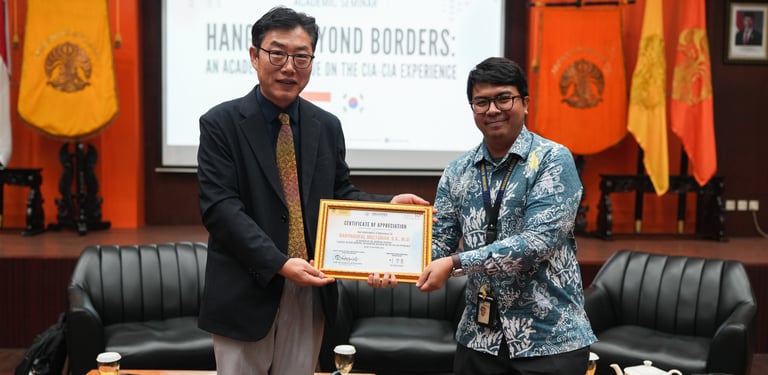
KIC FISIP UI holds academic seminar which explores one of the most unique and inspiring examples of cultural diplomacy between Indonesia and South Korea—the introduction and adoption of Hangeul in the Cia-Cia tribe of Bau-Bau, Southeast Sulawesi.
NEWS
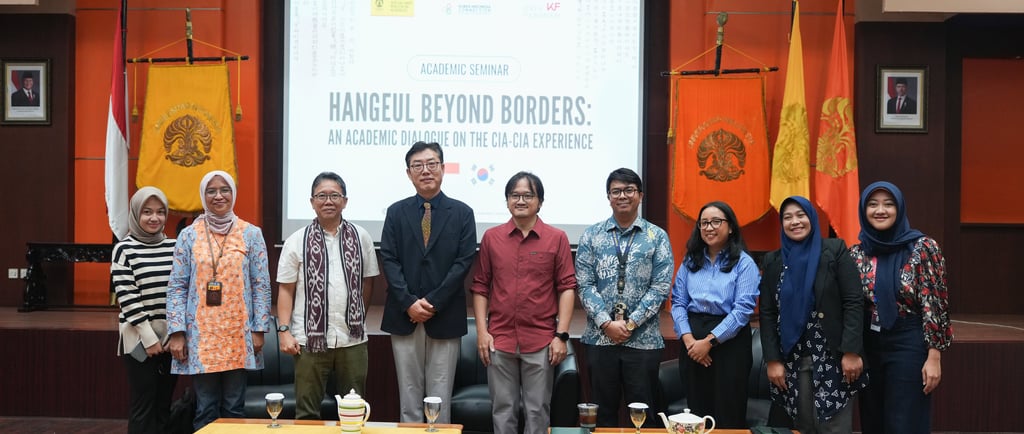
The Faculty of Social and Political Sciences at Universitas Indonesia (FISIP UI), through the Korea–Indonesia Connection (KIC), successfully convened an academic discussion titled “Bridging Nations through Words: The Cia-Cia Story and Korea’s Cultural Diplomacy.” The event brought together scholars, researchers, journalists, and students to examine the unique case of the Cia-Cia community in Bau-Bau, Southeast Sulawesi, which has adopted Hangeul as a writing system for its local language. This phenomenon has attracted significant public and academic interest in both Indonesia and the Republic of Korea.
The program opened with remarks from Prof. Semiarto Aji Purwanto, Dean of FISIP UI, who emphasized that the Cia-Cia case should be understood not only as a linguistic development but also as a point of intersection between culture, diplomacy, and media. He highlighted the long history of writing systems in the region and the importance of exploring how Hangeul came to be used to express the Cia-Cia language.
Prof. Semiarto stated, “This is a compelling process of cultural translation. The Cia-Cia community has experienced multiple writing systems, from Bugis and Arabic to the Roman alphabet. The adoption of Hangeul invites deeper anthropological inquiry. I extend my appreciation to KIC and the Korea Foundation for creating a space for discussions that enrich our understanding of cultural dynamics.”
Mr. Lee Sang Hoon, Director of the Korea Jakarta Office, delivered his welcoming remarks by expressing his appreciation for the collaborative spirit demonstrated through this forum. He noted his personal interest in understanding why a local community in Indonesia would choose Hangeul to represent its language, given the script’s national significance for Korean people.
He added, “Hangeul carries deep historical and emotional value for Koreans. Seeing how it is used beyond Korea, particularly in Indonesia, highlights an unexpected depth of cultural connection. This initiative illustrates how communities can engage with each other in meaningful and creative ways.”
The discussion was moderated by Dr. Phil. Geger Riyanto, Lecturer in Anthropology at FISIP UI, who underlined the importance of exploring how Hangeul is being adapted in the daily practices of the Cia-Cia community. He also noted the wider sociocultural context, including dialect variations, migration patterns, and the challenges of teaching and sustaining local languages.
Two featured speakers contributed to the session:
Darynaufal Mulyaman, S.S., M.Si., Lecturer of International Relations at Universitas Kristen Indonesia
Nicky Aulia Widadio, Journalist at BBC Indonesia
Ms. Nicky Aulia Widadio presented her findings and observations from journalistic research and field reporting. She explained how national and international media have portrayed the Cia-Cia adaptation of Hangeul and described the enthusiasm as well as the practical challenges faced by local communities, especially in education, resources, and long-term policy support.
She noted, “The adaptation of Hangeul brings pride to the Cia-Cia community. However, its use remains limited in practice, with implementation constrained by the availability of trained teachers, local curriculum frameworks, and consistent institutional support.”
Mr. Darynaufal Mulyaman provided an academic perspective based on his research conducted between 2018 and 2019, which examined the cooperation between Seoul Metropolitan Government and the Bau-Bau City Government during the initial introduction of Hangeul in 2008. He discussed the role of city-to-city diplomacy, soft power dynamics, and the shift from government-led programs to civil society initiatives as official support concluded.
He explained, “My research shows that the Cia-Cia community accepted Hangeul willingly. However, the continuity of the program depends heavily on local governance mechanisms, administrative coordination, and long-term educational commitment.”
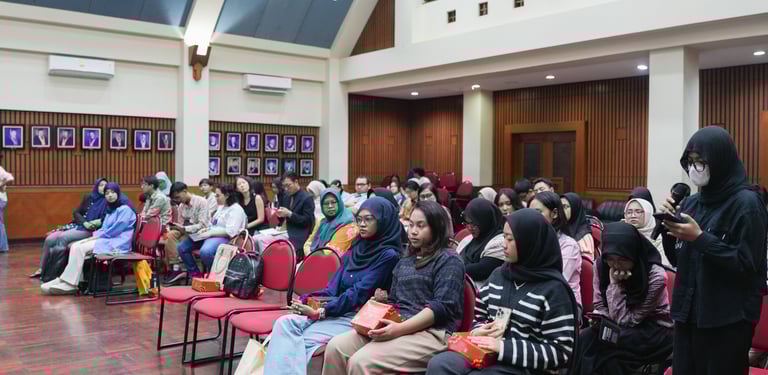
The question-and-answer session featured contributions from students of FISIP UI and international participants, who raised inquiries about cultural diplomacy strategies, potential economic implications, long-term linguistic preservation, and the responses of national and regional governments toward indigenous language revitalization. The speakers emphasized that the preservation of local languages requires sustained collaboration between policymakers, researchers, educators, and the communities themselves.
In closing, Dr. Geger Riyanto highlighted the importance of maintaining an anthropological perspective when discussing identity, language policy, and intercultural dynamics. He expressed appreciation for the empirical insights offered by the speakers, which enriched the overall understanding of the Cia-Cia case.
This academic forum served as an important platform for strengthening dialogue between Indonesia and the Republic of Korea. It also demonstrated how cross-cultural engagement, research collaboration, and media representation continue to shape the evolving relationship between the two countries. “Through this dialogue, we aim to explore the Cia-Cia and Hangeul phenomenon from multiple perspectives, recognizing that language is not merely a tool of communication, but a force that connects histories and opens new avenues of collaboration between Indonesia and Korea,” Dr. Getar Hati, Program Director of KIC FISIP UI.
Korea–Indonesia Connection
Bridging dialogue on Korea-Indonesia relations.
Contact us
Collaborate
kic.fisip.ui@gmail.com
© 2025. All rights reserved.