


2026 ASEAN–Korea Academic Conference Highlights ASEAN–Korea Collaboration in Advancing Southeast Asian Studies
The 2026 ASEAN–Korea Academic Conference, a two-day international academic forum, was successfully held on February 9–10, 2026 at the Juwono Sudarsono Auditorium, Faculty of Social and Political Sciences (FISIP), Universitas Indonesia. The conference brought together scholars, researchers, and graduate students from ASEAN Member States and the Republic of Korea to strengthen academic collaboration and advance Southeast Asian Studies through cross-regional dialogue.
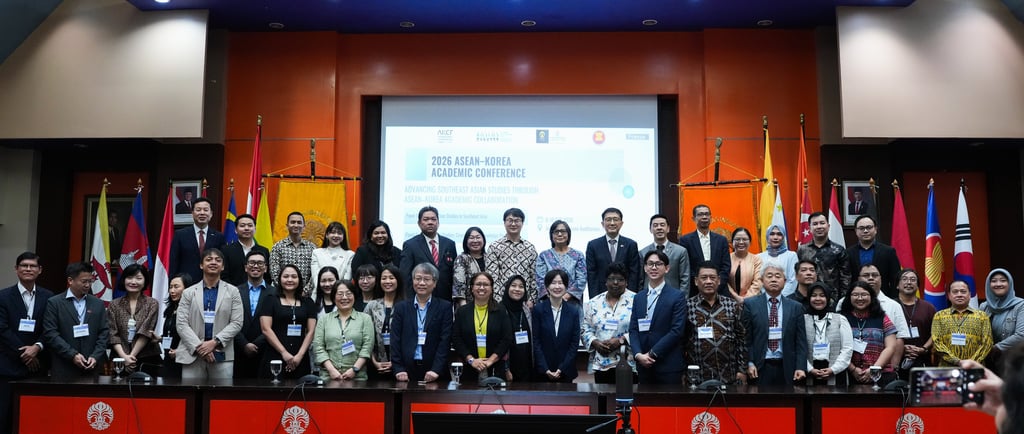
Depok, Indonesia — 9–10 February 2026 — Scholars from ASEAN Member States and the Republic of Korea convened at Universitas Indonesia for the 2026 ASEAN–Korea Academic Conference, a two-day international forum aimed at advancing Southeast Asian Studies through sustained ASEAN–Korea academic collaboration.
Held at the Juwono Sudarsono Auditorium, Faculty of Social and Political Sciences (FISIP), Universitas Indonesia, the conference was organized under the ASEAN–Korea Platform for Great Minds (AKPGM) project, which is supported by the Government of the Republic of Korea through the ASEAN–Korea Cooperation Fund (AKCF). The event brought together senior academics, emerging scholars, and graduate researchers to engage in critical discussions on Southeast Asian Studies, cross-regional knowledge production, education, and contemporary ASEAN–Korea relations. Representatives from the Permanent Mission of Thailand to ASEAN, Mission of the Republic of Korea to ASEAN, ASEAN Secretariat, and the ASEAN University Network also attended the event.
The conference was officially opened by Prof. Kim Dong-Yeob, President of the Korean Association of Southeast Asian Studies (KASEAS), who emphasized the importance of strengthening scholarly networks between ASEAN and Korea. He commented on the conference’s significance on the ASEAN-Korea academic network, “The aim of the conference is to foster cross-national dialogue among scholars and practitioners through the ASEAN-Korea academic network. This academic event honors the spirit of cooperation first established in 1994 to secure a progressive future for Southeast Asian studies and ASEAN-Korea relations”, stated Prof. Kim Dong-Yeob.
Prof. Evi Fitriani, Ph.D., Dean of the Faculty of Social and Political Sciences, Universitas Indonesia, highlighted the role of universities in fostering regional understanding and people-to-people connectivity through academic cooperation. “In this time of geopolitical pressures, it is very important for us and countries to build a stronger collaboration to cultivate better understanding on global issues and its impact towards the region. It is our role as academics to advise policy-makers on how we can respond to those daunting challenges.”, said Prof. Evi Fitriani, Ph.D. during her welcome remarks.
The 2026 ASEAN–Korea Academic Conference reflects the growing depth of ASEAN–Korea relations following the establishment of the ASEAN–Korea Comprehensive Strategic Partnership (CSP). By providing an inclusive platform for dialogue among scholars from diverse disciplinary and national backgrounds, the conference seeks to strengthen the intellectual foundations of ASEAN community-building and ASEAN–Korea cooperation.
The program featured four thematic panels:
Southeast Asian Studies in Southeast Asia
Korea–ASEAN Studies: Cross-Regional Knowledge Production
Educating Southeast Asia—Programs, Pedagogies, and Partnerships
Contemporary Issues in ASEAN–Korea Relations: Challenges and Future Directions
Through these panels, participants explored issues ranging from education and pedagogy to socio-cultural transformation, diplomacy, and regional geopolitics, from comparative and interdisciplinary perspectives.
The implementation of the conference was made possible through the continued support of the AKCF, which continues to play a key role in promoting people-to-people connectivity and sustainable academic collaboration between ASEAN and the Republic of Korea. Through his opening remarks, Chargé d'Affaires of the Mission of the Republic of Korea to ASEAN, Mr. Jeonghan Hahm wished everyone an inspiring and fruitful discussion, while expressing hope that this conference will serve also as an opportunity to strengthen exchanges of human intellect, mutual respect, and shared hope between the ROK and ASEAN.
As one of the local organizing institutions, Korea–Indonesia Connection (KIC), FISIP UI, underscored the importance of long-term institutional partnerships in sustaining ASEAN–Korea academic engagement. According to Getar Hati, PhD., Program Director of KIC FISIP UI, the conference represents an important step in sustaining cross-regional scholarly engagement. “KIC FISIP UI is honored to serve as the local host institution for this conference. We see this gathering as a strategic platform for meaningful connection that brings together representatives from across ASEAN and Korea, fostering meaningful opportunities for sustained collaboration in academic, social, and cultural spheres.”
The conference also demonstrated its strong academic reach through broad and diverse participation. It brought together four panel chairs, sixteen presenters, and sixteen discussants from universities across ASEAN Member States and the Republic of Korea, representing various academic backgrounds and fields of expertise. This diverse composition encouraged lively discussions, comparative perspectives, and meaningful exchange among scholars at different career stages, reinforcing the conference’s role as an inclusive platform for dialogue and collaboration in the region.
“This conference is an important starting point for expanding Southeast Asian Studies. With frameworks such as ASEAN Plus Three, there is strong potential to broaden participation and invite more researchers, which would further enrich scholarly exchange and deepen regional understanding,” said Prof. Myo Oo from Myanmar Future Forum, as one of the participating discussants.
Through the 2026 ASEAN–Korea Academic Conference, participating institutions and scholars aim to strengthen the academic infrastructure supporting Southeast Asian Studies, foster the development of emerging Southeast Asianists, and contribute to a shared intellectual foundation for ASEAN community-building and ASEAN–Korea relations.
Korea–Indonesia Connection
Bridging dialogue on Korea-Indonesia relations.
Contact us
Collaborate
kic.fisip.ui@gmail.com
© 2025. All rights reserved.